
Divisibility and factors
A number is considered divisible by another number (divisibility) when the result of the division is an integer and there is no remainder. The number which divides that number is called a factor of that number or its divisor. Division is an operation that is the opposite of multiplying and the property that a number can be divided by another number is called divisibility.
For example: If you divide the number 16 with the number 2, you will get the number 8 as a result and no remainder. That means that the number 16 is divisible by the number 2 and that 2 is a factor of 16. But if you divide the number 16 with the number 3, you will get the number 5 as a result with 1 as the remainder. This means that 16 is not divisible by 3 and 3 is not a factor of 16.
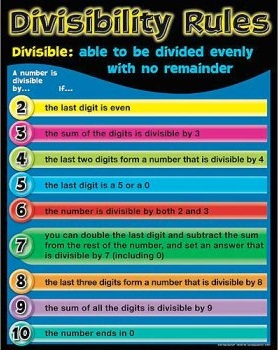
The basic rules that can help you determine whether a number can be divided by another number (and which one) are ilustrated in the picture below. These rules are particularly useful in prime factorization or finding the least common multiple or the greatest common factor.
Divisibility exams for teachers
There are tricks and shortcuts in the process of determination whether a number is divisible by another number.
Every number, including prime numbers, is divisible by the number 1 and itself.
All even numbers (those ending in 0, 2, 4, 6 or 8 ) are divisible by 2.
If you calculate the sum of all the digits in a number and that sum is divisible by 3, then the number is divisible by 3 as well.
A number is divisible by 4 if the last two digits in that number are divisible by 4.
Every number ending in 0 or 5 is divisible by the number 5.
A number is divisible by 6 if it is also divisible by 2 and 3.
If the last three digits in a number are divisible by 8, then that whole number is divisible by 8.
The same rule applies for checking if a number is divisible by the number 9 as it does for number 3. If the sum of all digits in the number is divisible by 9, then the entire number is divisible by 9.
Every number ending in 0 is divisible by the number 10.
Factoring exams for teachers
| Exam Name | File Size | Downloads | Upload date |
| Factoring all positive factors | 119.1 kB | 3798 | September 3, 2019 |
| Factoring numbers without exponents | 125.7 kB | 3092 | September 3, 2019 |
| Factoring with exponents | 129.8 kB | 3159 | September 3, 2019 |
Divisibility and factoring worksheets for students
| Worksheet Name | File Size | Downloads | Upload date |
|
Positive
|
|||
| Divisibility of positive integers | 137.7 kB | 3280 | September 3, 2019 |
| Divisibility of positive decimals | 192.9 kB | 2325 | September 3, 2019 |
| Divisibility of positive fractions | 252.6 kB | 2180 | September 3, 2019 |
| Divisibility of positive mixed numbers | 227 kB | 2107 | September 3, 2019 |
| Divisibility of positive improper fractions | 248.8 kB | 2078 | September 3, 2019 |
|
Non positive
|
|||
| Divisibility of integers | 143.7 kB | 2459 | September 3, 2019 |
| Divisibility of decimals | 222.3 kB | 2084 | September 3, 2019 |
| Divisibility of fractions | 260.9 kB | 2221 | September 3, 2019 |
| Divisibility of mixed numbers | 276.9 kB | 1944 | September 3, 2019 |
| Divisibility of improper fractions | 234.4 kB | 1907 | September 3, 2019 |
|
Factoring numbers
|
|||
| Factoring | 198.2 kB | 3397 | September 3, 2019 |
 Home
Home  Contact